

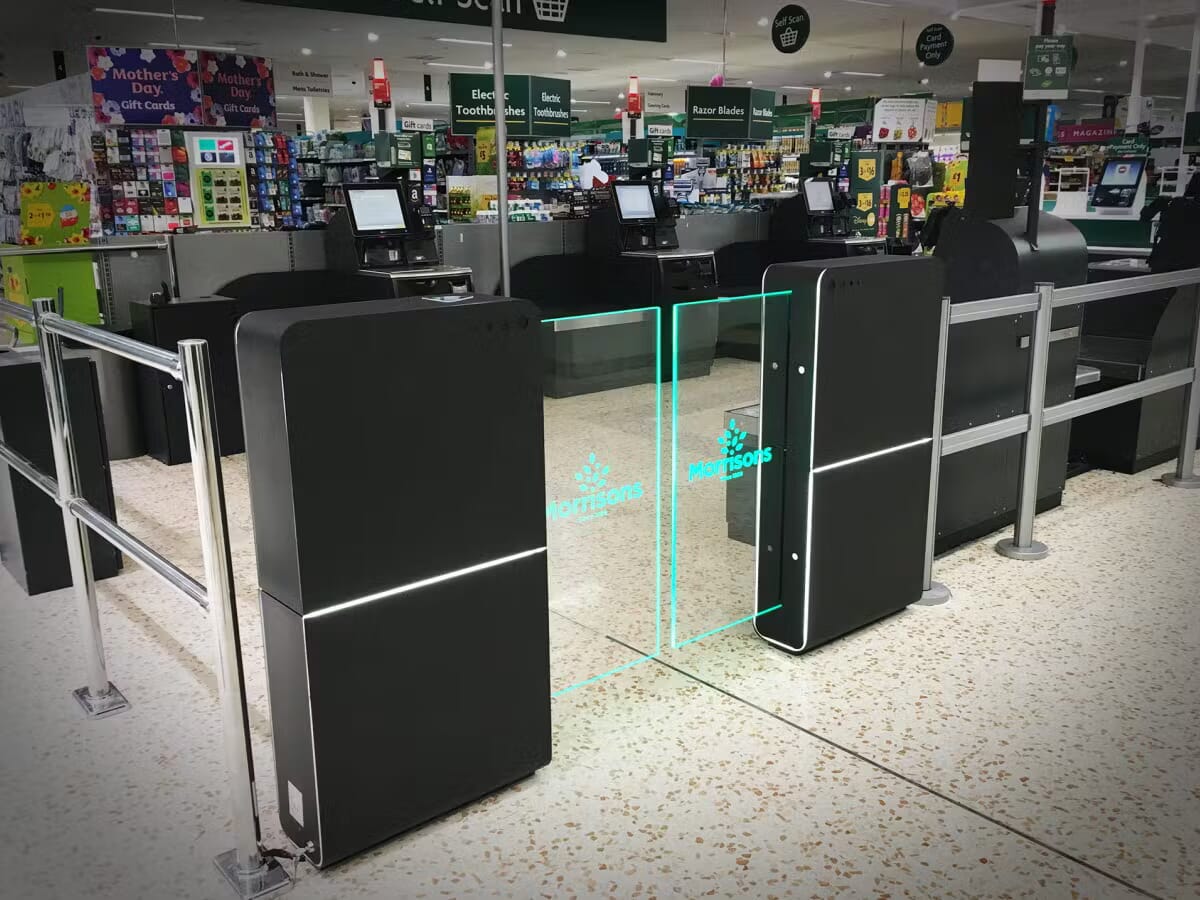
Do Self-Checkout Exit Gates Reduce Shrink? The evidence
Self-checkout exit gates sound straightforward and sensible. Put a barrier at the exit, deter walkaways, reduce shrink. But in practice, the decision, and the implications, are far more complex than simply installing the hardware.
The gate itself is only one variable in a bigger equation involving store layout, customer expectations, staffing models, maintenance realities and the question of whether a physical barrier is even the right intervention for your business. For some retailers, gates have delivered sustained, measurable shrink reductions. For others, the trade-offs point firmly in a different direction.
Drawing on case studies and open discussion among self-checkout experts from retailers across nine countries, including Germany, the UK, Australia, the USA, the Netherlands, Ireland, Finland, France and Portugal, and informed by ECR’s ongoing benchmarking study of SCO use among global retailers, here is what the evidence shows and what retailers can take from it.
Self-checkout exit gates reduce shrink and walkaways
Exit gates deliver a measurable reduction in self-checkout losses. For example, from an upcoming new report on loss at the self checkout, one retailer found a 30 to 40 basis point improvement in shrink while in another case, a retailer recorded a 28% reduction in walkaways when the gates were deployed.
Individual retailer results reinforce the pattern. A UK grocery retailer with gates in 45% of its estate reported a 6% reduction in total loss, with substantially larger reductions in their six worst-affected product categories: laundry products, medicines and other branded goods.
A second UK grocer, four years into its programme and covering 95% of its main estate, reported an ongoing 8 to 11% shrink reduction measured through wall-to-wall stocktakes. A Dutch retailer saw a more modest 3% decrease, likely reflecting the fact that gates have been standard in the Netherlands for years. An Australian retailer with gates in over 700 stores reported double-digit basis point reductions.
One consistent finding: the strongest returns come from the highest-loss stores. As programmes extend into lower-risk locations, the per-store benefit tapers. That matters for business case planning: the first tranche of stores will always deliver the biggest returns.
POS integration is the direction of travel
Two main execution models exist. In the first, customers scan a paper receipt to open the gate. In the second, the gate links directly to the POS: once payment completes, the system signals the gate to open automatically.
Both work. But the trend is firmly towards POS integration, and the reasons are practical. Receipt scanning introduces friction that retailers increasingly want to avoid. Customers who opted out of paper receipts need them again. Some do not pick them up, creating queues and confusion at the exit. As one participant put it, the industry risks going “back to the Stone Age” by reintroducing paper receipts specifically for gate validation: a step backwards that several retailers are now actively trying to reverse with mobile receipt alternatives.
POS integration removes the friction. The customer pays, the system confirms, the gate opens. No scanning, no fumbling. For retailers already upgrading till systems, the integration cost is relatively modest. One UK grocer that began with receipt scanning is converting to POS-integrated gates this year as part of a wider till upgrade.
POS integration is not without its own challenges. One Australian retailer reported a 93% accuracy rate for the gate opening on time as the customer approaches. That means roughly one in fourteen customers hits a delay or needs a manual override. The target is 94 to 95%. When the system works, customers barely notice it. When it does not, complaints spike. Reliability is not a nice-to-have: it is the difference between a smooth exit and a frustrated queue.
Glass gates break. Plan for metal.
If there is one operational lesson that unites retailers across every market, it is this: glass sliding gates are expensive to maintain and slow to repair. Multiple retailers described moving from glass (Sigma-style) gates to metal (Alpha-style) alternatives. Glass gates look better and provide a more complete physical seal. But the sliding mechanisms have intricate internal workings, parts take time to source, and the entire unit often needs dismantling for repair. Downtime is the real problem: a broken gate that sits open for days or weeks undermines the deterrent effect and erodes store teams’ confidence in the programme.
Metal gates are simpler, cheaper to maintain and faster to fix. They can be forced open, which makes them less physically secure. But several retailers reported comparable loss reduction, because the primary function of a gate is deterrence, not containment. A gate that works 95% of the time is more effective than an impressive gate that sits broken for a fortnight.
One practical addition worth noting: a Dutch retailer installed a physical sound alarm triggered when someone forces the gate, alerting staff to respond immediately.
Training and compliance make or break the investment
A gate is only as effective as the team operating around it. ECR’s survey of over 6,000 SCO supervisors has shown how critical frontline staff are to every SCO intervention. Gates are no exception.
Retailers with the best results invested in dedicated e-learning modules explaining why gates are there and how to handle customer questions. One Australian retailer reported over 30,000 team members completing a training module focused on positive customer interactions at exit gates. A UK grocer built gate utilisation into its daily shrink health check and made it part of the store’s periodic compliance review.
The pattern is clear: stores where colleagues understand the system, keep gates closed when they should be, and know how to assist customers deliver better utilisation rates and fewer complaints. Stores where the gates arrived without explanation or accountability drift towards leaving them open.
Customer acceptance follows a remarkably consistent curve. Initial resistance lasts a week or two, then stops. In the UK, several retailers confirmed that gates have simply become part of the shopping experience. Customers compare them to ticket barriers on public transport: unfamiliar the first time, invisible the second. In the Netherlands and Finland, where gates have been standard for years, retailers report virtually no complaints.
When gates are not the answer
Not every business could install exit gates. For some retailers, the evidence points towards different interventions or a different sequencing of priorities.
Space is the most obvious constraint. A UK convenience retailer with 80% of stores under 3,000 square feet (280 square metres) has seen positive results from a small trial but cannot physically fit gates into most of its estate. Customer flow in small-format stores works differently from big-box retail. A gate that slows exit in a shop where people pop in for a sandwich creates more problems than it solves.
Throughput is another. Two large US retailers described the challenge of adding any friction to SCO areas that process very high volumes at peak. In stores where 50% or more of transactions go through self-checkout, even a few seconds per customer adds up fast. Their focus is on solving upstream: fixing non-malicious walkaways caused by confusing contactless payment flows, deploying POS alerts to flag failed payments in real time, and investing in computer vision to identify scanning issues before the customer ever reaches an exit.
That echoes ECR’s own research on walk-offs, which found that payment ambiguity, not malicious intent, drives the majority of walkaway incidents.
Brand values can also be a legitimate reason to choose a different path. A major German retailer with over 4,200 stores across Europe made a deliberate decision not to install gates because its stores are designed as open, welcoming spaces. Physical barriers contradict that brand promise. The retailer monitors shrink, acknowledges the issue, and has considered gates for high-risk locations, but has so far chosen alternative approaches. That is not avoidance. It is a strategic trade-off, and one that pushed the wider group to think harder about when a gate is the right tool and when it is not.
The alternatives gaining ground
Several approaches emerged as serious complements or alternatives to physical gates.
Computer vision and AI-based monitoring can identify both malicious and non-malicious loss at the point of scanning, before the customer reaches the exit. Already advanced in the USA, UK and Australia, the adoption is now beginning to happen in countries such as France that previously had a far more hesitant approach. Whether this can eventually reduce or replace the need for physical gates remains to be seen, but the direction is worth watching.
POS alerts pushed to staff headsets can flag failed payments to the SCO host in real time, enabling a human intervention rather than a mechanical one. Store design that creates better sight lines and natural zones of control can reduce walkaways without adding hardware. ECR’s research into human-centred SCO design reinforces this point: the design of the entire checkout environment, from queue flow to payment confirmation to exit route, shapes whether customers scan accurately, complete payment and leave correctly. A gate addresses the last step. Better design addresses the whole journey.
Hybrid approaches matter too. One retailer described using entrance gates alongside SCO exit gates to create a strict one-way flow through the self-checkout area. The unexpected benefit went beyond loss: it stopped customers using the SCO corral as a cut-through into the store, which meant staff had a cleaner, less chaotic environment to monitor and could actually see what was happening at the tills.
What retailers should weigh up
For retailers considering exit gates, the evidence points to a few practical conclusions.
Gates work. The shrink reduction is real: roughly 6 to 11% where gates are well deployed, with the strongest gains in high-loss stores and high-loss product categories. The retailers who shared data on exit gates in the ECR benchmarking data brings further evidence to this point.
POS integration should be the target. Receipt scanning is a workable interim step, but the friction it creates is a known weakness. If till upgrades are on the roadmap, building in gate integration now avoids a costly retrofit later.
Consider choosing metal over glass unless there is a strong reason not to. Maintenance cost and downtime may erode the business case faster than any shrink reduction builds it.
Invest in training and compliance from day one. A gate without store engagement is just furniture.
Measure carefully. Several retailers acknowledged that isolating the impact of gates from concurrent interventions (scan-assist software, weighted SCO, improved staffing) is genuinely difficult. Build the measurement framework before the rollout, not after.
Plan for displacement. When one retailer installs gates and a neighbouring competitor does not, offenders shift. In competitive catchments, gate adoption tends to become a collective decision rather than a solo one.
And consider whether a gate is the right intervention at all. For some formats, some brands and some types of loss, the answer may be better design, better technology or better-supported staff.
The ECR Retail Loss self-checkout working group brings together SCO experts from more than 450 retailers worldwide. It meets regularly and is open to all retailers at no cost.




