
Self Checkout Walk Offs – Retailer Insights
Concerns about self-checkout walk-offs are growing. When shoppers don’t pay for the items they have scanned at the self checkout (SCO), either by accident or design. There’s increased sense of concern about the issue as the use of contactless grows
This article shares five key insights and possible action steps for retailers. These have been drawn from the findings of a benchmark survey of 35 retailers from around the world for ECR Retail Loss, a working group meeting with the SCO experts from over 60+ retailers represented and a case study presentation from a UK convenience retail business operating over 2,000 stores. Here goes:
1. Self-checkout walkaways are mostly a systems problem and not a theft problem
Across the survey and from the case study, the dominant driver of walkaways is payment friction and ambiguity, not malicious intent.
Common triggers:
- Contactless “soft declines” (SCA / step-up to PIN)
- Slow or unclear payment processing
- Poor or missing confirmation that payment has failed
The retailer data showed that once the customers clearly understood “your payment hasn’t gone through”, the walkaways, as they measured them, reduced from 0.13% to 0.02%
If your SCO UX leaves any room for doubt, customers will fill that gap by assuming they’ve paid.
2. Most retailers don’t actually know how big the problem is
The research surfaced a major blind spot:
- Heavy reliance on manual logs or paper reporting
- Many retailers don’t measure walkaways at all
- Void transactions are often used as a proxy — but this is problematic.
The case study retailer demonstrated that:
- “Voids” massively overstate walkaways
- True stock-loss walkaways were a *small subset* once data was separated properly
Without separating abandoned, moved till, failed payment, and stock taken, it is hard to have reliable and trusted data to measure and then manage the problem.

3. The problem of Walkaways are usually concentrated, and not evenly spread
Just like other SCO losses:
- A minority of stores, times, and layouts drive a disproportionate share
- Late night, low staffing, high friction environments show spikes
Understanding the drivers of variation is needed, to help ensure the right controls are introduced-
4. Interventions can work — but are hard to measure
Retailers reported the most effective controls as:
- Clear payment confirmation messaging
- Audio + visual alerts on failed payments
- Strong SCO hosting / guardianship
- Exit gates integrated with payment state
But the research showed a huge gap:
- Many interventions are yet to be deployed
- Very few are measured for impact
Encouragingly, the case study proved that UX changes and audio can reduce the walkaways problem from 0.13% to 0.02% of all transactions,

5. “Plausible deniability” is the real risk going forward
As contactless limits become variable by bank and customer:
- Customers can genuinely believe they’ve paid
- Bad actors can deliberately exploit that ambiguity
Designing out” ambiguity is now an urgent fraud prevention strategy, not just a CX improvement.

Taking the insights from the research, the case study and retailer focus group discussion, here could be five action steps for retailers to consider.
Five ways retailers can reduce self-checkout walk-offs
Step 1: Establish Robust and Inarguable Measures for Walk Offs
- Stop using “voids” as your walkaway metric
- Agree a clear internal definition of a walkaway. For example, transaction started, payment not completed, stock not recovered
- Look to introduce reason codes for SCO hosts to use when clearing transactions
- Abandoned transaction but stock present
- Abandoned transaction and stock missing
- Abandoned transaction, shopper moved to other SCO machine
- Investigate and use payment processor reason codes to identify, track and monitor quantities of:
- Soft declines
- Hard declines
- Step-up authentication failures
- Overlay transaction value to quantify financial exposure to create compelling “size of the prize”
From the case study, after implementing reason codes on the monitor, they found that only 8% of their voids could be considered “walk offs”….

Step 2: Fix the payment experience first – remove the risk of unintentional losses
- Add unmissable payment-state messaging:
- Your Payment processing
- Your Payment failed
- Please Insert card and enter PIN
- Don’t run the risk of under communicating, use visual and audio prompts.
- Full-screen visual
- Audio prompt
- Light or colour change visible to staff
- Prevent receipt printing until payment success
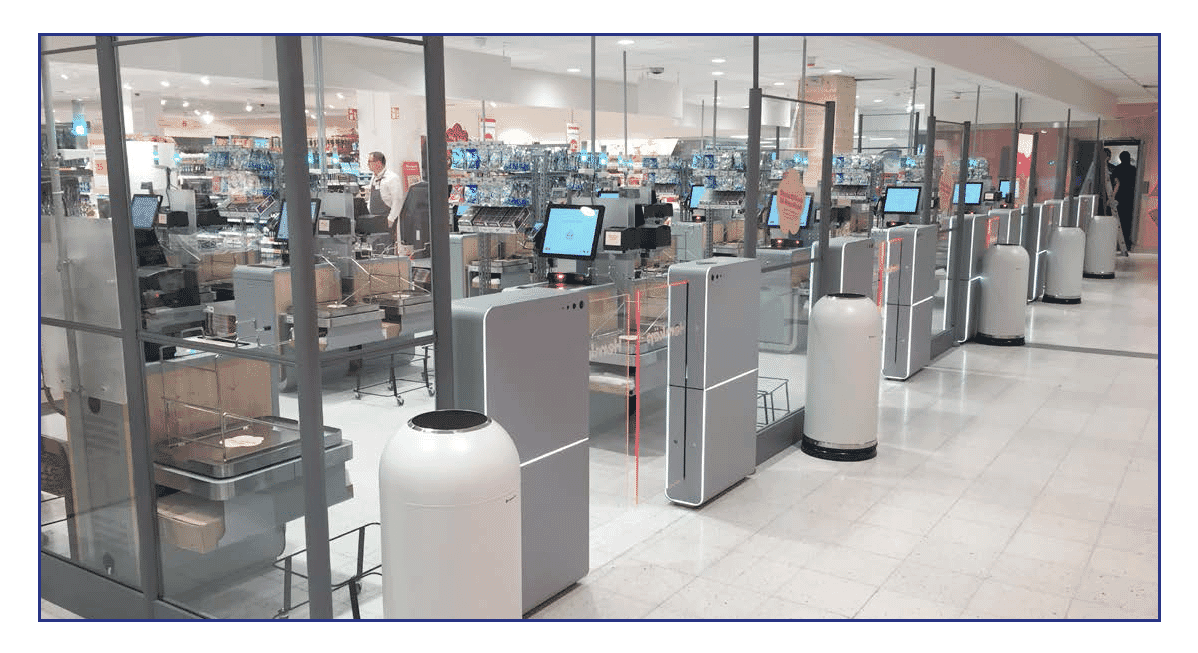
- Delay exit access until payment success is confirmed via AI gates
- Remove unnecessary “press pay” or payment-type selection steps.
- A USA retailer reported significant improvements in walk-offs by implementing “Fast Pay” that simplified the payments process
Step 3: Support staff without putting them at risk
- Ensure that the design of the SCO host role is about guardianship and support, and not security or policing
- Train staff to challenge the process, not the person
- “Looks like the machine didn’t finish that payment, please let me help”
- “These machines are always breaking down, let me see what’s gone wrong”
- “Sorry, we are having problems with the machines today, let me see what’s gone wrong now”
- Prioritise hosting at:
- Peak traffic
- Late night
- Known problem stores
- Ensure that safety is prioritised in any communications around walkaway recovery.
Step 4: Use friction selectively, not everywhere
- Consider exit gates where the risk justifies it
- Integrate gates with:
- Receipt validation
- Payment success state (not just receipt validation)
- Consider basket size caps in high-risk locations
Step 5. Close the loop with evidence
- Establish a baseline walkaway rate, ideally before any intervention
- Pilot changes in matched store groups
- Track: Walkaways per 1,000 SCO transactions
-
- £ / $ loss per walkaway
- Change in customer complaints
Summary
Walkaways/self-checkout walk-offs are currently one of the, but not the biggest, drivers of loss at the fixed self-checkout, however, with changes to the contactless limits for shoppers, the jeopardy for retailers is growing.
The good news from the research and case study is that losses are usually a design failure, occasionally a staffing issue, and sometimes a theft problem, in that order, with the case study retailer confirming that when customers clearly know they haven’t paid, most of them fix it themselves.
The self checkout working group will continue to keep walkaways / walk-offs as one of their focus areas and will organise a follow up meeting in February 2027. In the meantime, if retailers would like a copy of the recording or the benchmark survey results, please send an email to colin@ecrloss.com