

Store security innovation, 2026: the future’s trust, not cost
Store security innovation: what other retailers are doing
Every retailer wants safer stores, while every finance director wants lower costs.
Too often, those two objectives collide.
For years, retailers have tried to solve the challenge of store security by asking the same question:
“How do we get the same service for less money?”
It sounds sensible.
But as retailers discussed at our recent meeting, led by Morrisons, continually reducing the cost of security guarding often creates exactly the opposite result.
Lower costs can ultimately produce poorer outcomes, more management effort and less value for the business.
The low-cost security trap
Many retailers recognise the pattern of this downward spiral.
- Procurement drives costs down.
- The lowest-cost provider wins.
- Experienced officers leave.
- Turnover increases.
- Reporting quality falls.
- Retailers lose confidence in the service.
- They introduce more audits, more contract management and more checking to ensure they are receiving what they are paying for.
Ironically, the effort required to manage the contract becomes another hidden cost.
Eventually, any store security innovation appears expensive.
Not because officers cost too much, but because the relationship has become centred on policing the supplier rather than preventing crime.
Introducing a different way to think about store security innovation
One retailer shared a very different approach with our working group.
Rather than asking: “How do we reduce the cost of guarding?”
The question became: “How do we create more value together?”
That subtle change transformed almost every aspect of the relationship.
- Instead of selecting purely on price, the retailer looked for a partner willing to invest alongside them.
- Instead of measuring only hours worked, they measured business outcomes.
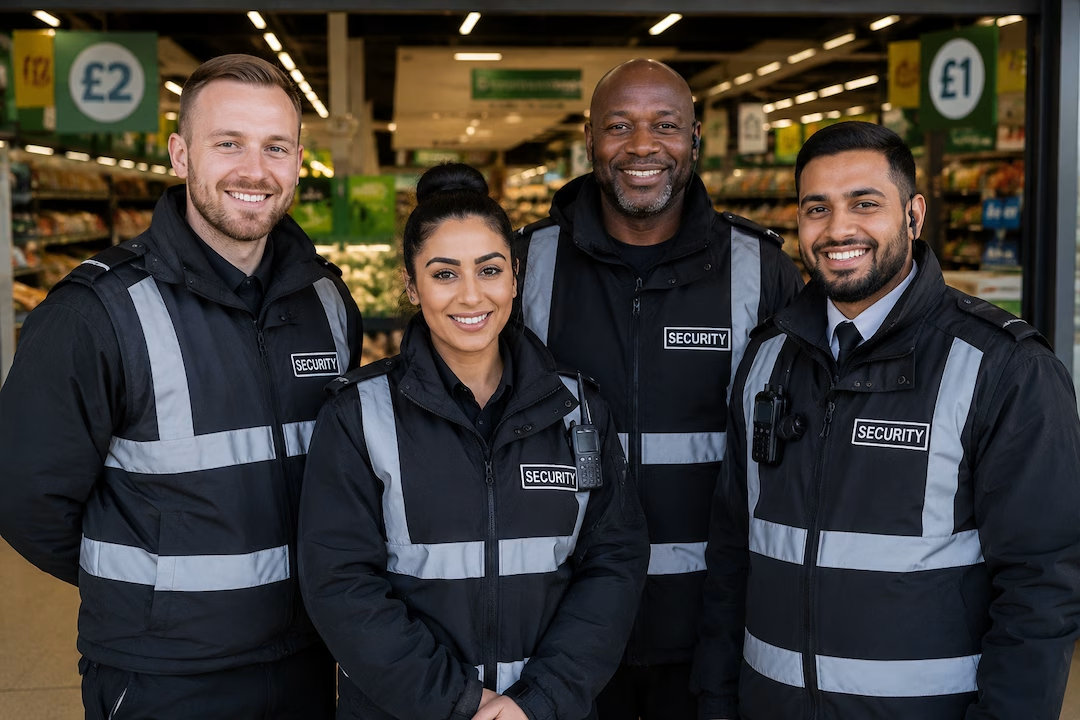
- Instead of treating officers as “bodies on the door”, they became part of the wider retail team.
Technology wasn’t introduced to replace security officers. Instead, it was introduced to make them better.
Why trust creates value
The retailer’s model can be thought of as a positive flywheel.
- Trust creates transparency.
- Transparency encourages shared objectives.
- Shared objectives justify investment in better people.
- Better officers become part of the retail operation rather than outsiders.
- Technology amplifies their capability through body-worn cameras, reporting tools and intelligence platforms.
- Better information enables smarter deployment.
- Smarter deployment uncovers new opportunities.
- Those opportunities create better business outcomes.
- Success builds even greater trust.
Then, the cycle begins again.
Instead of continually asking whether security guarding is worth the investment, retailers begin discovering entirely new ways to create value.
Technology is only part of the answer
One of the strongest messages from our discussion was that technology alone is not the solution.
Sure, body-worn cameras, AI and data-led deployment all have an important role.
But they work best when combined with skilled security officers who understand the store, recognise repeat offenders and contribute valuable intelligence rather than simply standing at the entrance.
Used well, technology amplifies the performance of people. It should not replace them.
Better measures create better decisions
The discussion also highlighted an important shift in how retailers evaluate security performance.
Traditional measures remain important.
But shift fulfilment, attendance and contract compliance no longer tell the whole story.
Leading retailers are increasingly interested in questions such as:
- Are customer complaints falling?
- Is officer retention improving?
- Is reporting becoming more accurate?
- Are more crimes being reported to police?
- Are stores more satisfied with the service?
- Is intelligence leading to better deployment?
- Can we clearly demonstrate return on investment?
Those measures move the conversation away from cost and towards business value.
Store security innovation is changing the role of guards
Perhaps the biggest change across the industry is cultural.
The traditional image of the security guard standing at the front of a store waiting for something to happen is gradually disappearing.
Instead, officers are becoming part of an integrated security ecosystem.
- They gather intelligence.
- Support investigations.
- Use digital reporting tools.
- Work alongside retailers, police and technology providers.
- Help determine where to deploy resources next.
In the most progressive organisations, they are no longer viewed simply as a security cost. They have become an operational asset.
The future belongs to partnerships
One message came through consistently from retailers across multiple countries.
The strongest results are emerging where retailers and providers stop behaving like customers and suppliers.
Instead, they behave like partners that share objectives, information, and innovation.
Increasingly, those who do this also share success.
That shift creates something far more valuable than another procurement exercise.
It creates a relationship capable of continually adapting as retail crime evolves.
From controlling cost to creating value
Store security innovation is not simply about deploying more officers or installing more technology.
It is about building an operating model where trusted people, intelligent technology and transparent partnerships reinforce one another.
Retailers that remain trapped in the low-cost cycle may find themselves spending more time managing contracts than preventing crime.
Those who invest in trust, capability and innovation are beginning to discover something different.
- Better information.
- Better decisions.
- Better security.
And ultimately, better business outcomes.
If you want to gain a better understanding of the tasks required to create the optimal conditions for effective loss prevention, sign up for our 2026 Executive Leadership Programme.




