

Designs against shoplifting finale: 11 smart fixes
Designs Against Shoplifting: the student design competition finale
Designs Against Shoplifting is the finale of a new anti-theft packaging design competition with Central Saint Martins, built around a simple (and slightly uncomfortable) question: how do we cut shoplifting without turning stores into fortresses?
The most promising ideas don’t look like “security” at all. They look like better packaging, smarter fixtures, and small behavioural cues that raise perceived risk or reduce opportunity at the exact moment theft happens.
This post shares what we’ve published in the final report, what stood out in the finalists’ work, and how retail teams can adapt these ideas to practical in-store solutions.
What the challenge asked students to do
The ECR Design Challenge 2025 brief asked students to develop product protection concepts that tackle three tensions at once: reduce theft, reduce waste, and avoid the “locked cabinet” experience that slows shopping and irritates customers.
In practice, that meant thinking about packaging, point-of-sale displays and fixtures, and how offenders actually behave in store. The work was developed with the Design Against Crime Research Lab and informed by retail specialist advisors from across the sector.
Central Saint Martins hosted the competition as a formal client-style project, and the catalogue/report presents 11 selected designs out of 22 produced, chosen with retailer feedback on which ideas felt most worth exploring in the real world.
What “design-led” loss prevention really means
Most retailers already have plenty of tools: tags, CCTV, guards, locked displays, EAS, alarms. The problem is that many of these tools add friction for honest shoppers, or they shift workload onto colleagues, or they create packaging bloat that sustainability teams can’t defend for much longer.
Design-led loss prevention starts somewhere else. It begins with behaviour and opportunity: what’s being stolen, how it’s being stolen, and which part of the store experience makes theft easy (or makes intervention hard).
Security should be designed in, not bolted on.
That mindset is visible in the best student concepts. Many don’t rely on a colleague being present. Many reuse existing infrastructure. And many are trying to change the cost–benefit calculation of theft without loudly accusing anyone.
The 11 final concepts
Below are plain-English summaries of each finalist concept in the Designs Against Shoplifting catalogue. Some are immediately practical. Some are provocative. Most sit somewhere in between and need piloting before anyone makes big claims.
1) Reflect Points: mirrors that interrupt the moment
Reflect Points places mirrors and culturally resonant messaging next to high-theft cosmetics. It’s aimed particularly at teenage shoppers and is designed to create a “pause” at the moment of temptation, using humour and self-recognition rather than warnings.
The concept leans on behavioural psychology: people often want to see themselves as decent, and small prompts can help them stick to that self-image. In the catalogue, the designer tested messaging and iterated based on feedback, including playful phrases that feel native to the audience rather than corporate.
Retail takeaway: mirrors and messaging can be more than décor. Done carefully, they can support natural surveillance, reduce anonymity, and discourage opportunistic theft in a way that doesn’t punish the majority.
2) Uncanny: subtle cues that suggest someone is nearby
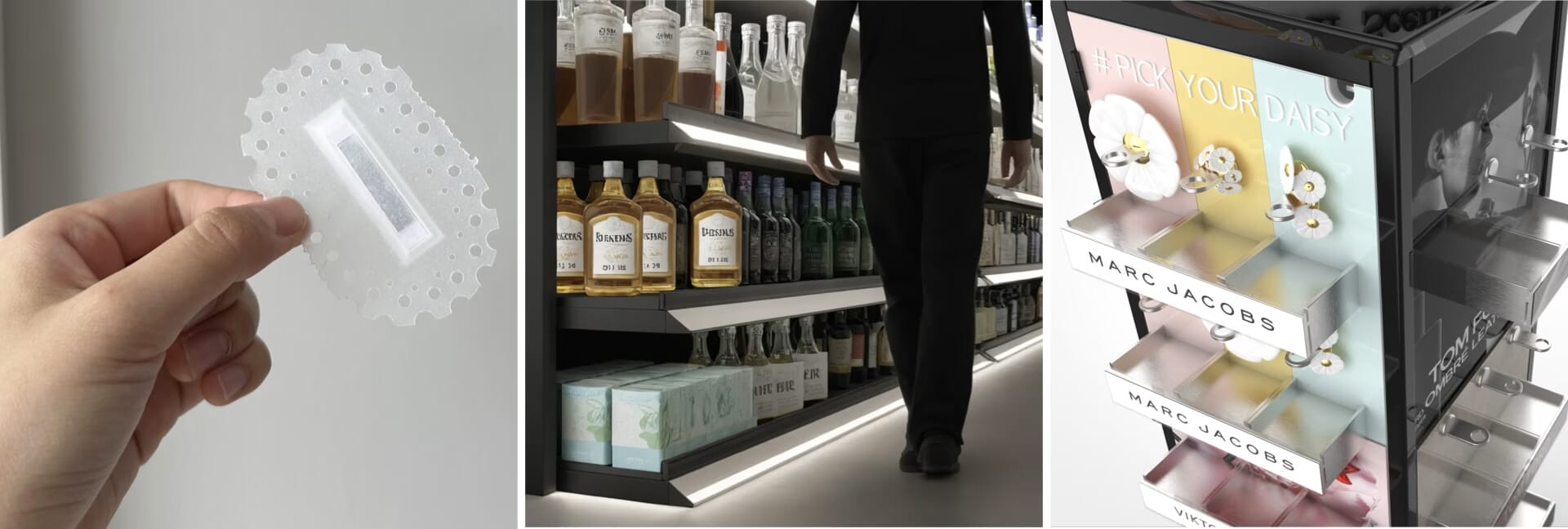
Uncanny integrates light and sound into shelving to create the illusion of human presence in quiet or unstaffed areas. Motion sensors trigger soft lighting and low-level ambient sound such as distant chatter or footsteps.
The idea is to disrupt the comfort of anonymity. For genuine shoppers, the cues should be unobtrusive. For opportunistic offenders, they may increase perceived risk and make certain techniques feel less “safe”.
Retail takeaway: there’s a middle ground between “nothing” and “guards everywhere”. Subtle environmental design can do work, especially in aisles where theft tends to cluster.
3) PickAware: a friendly sound cue when products are lifted
PickAware is a shelf-mounted sound bar designed (in this case) for wine aisles. When a bottle is lifted, the system plays a convivial sound, such as the clink of glasses.
It’s deliberately not an alarm. The cue is meant to signal that the action is “noticed” without escalating the situation. The catalogue also suggests it could serve dual purposes, such as seasonal messaging, so the hardware isn’t only “security”.
Retail takeaway: sound can change behaviour. The trick is calibrating it so it doesn’t annoy customers or create false positives that colleagues end up apologising for all day.
4) KeeperLink: tougher keeper cases, less staff dependence
KeeperLink is a proposed upgrade to existing keeper cases, designed to resist common magnetic tampering techniques while allowing customer-friendly unlocking at self-checkout after payment.
The concept combines multiple elements: a more protected locking mechanism, an automated unlock triggered by payment, and a system to link a specific keeper to a specific product in a database. It’s also framed as a retrofit to avoid replacing entire inventories of existing cases.
Retail takeaway: if your protection strategy depends on colleagues constantly unlocking products, you’re paying in labour and customer frustration. Smarter unlocking flows are worth exploring, but they must be resilient, secure and operationally simple.
5) Aurora: secure perfume testers without killing the experience
Aurora is a display system for perfume testers designed to reduce theft of testers and products while letting customers test scents independently. It aims to balance robust protection with a relaxed experience, and it leans into modularity and brand integration rather than “security furniture”.
Retail takeaway: fragrance is a category where theft risk and customer experience collide. The best solutions keep sampling easy while removing opportunities for quick concealment or bottle removal.
6) The Lift(er)-Proof Tag: a tag that tears when tampered with
This concept redesigns an AM-style tag using perforated, paper-based adhesive that tears into fragments if someone tries to lift it off quickly. The goal is to slow removal, leave visible residue, and make stolen goods harder to resell in clean condition.
There’s also a dispenser concept intended to speed up staff application during restocking. The sustainability angle is explicit: move away from single-use plastic construction where possible, and make end-of-life handling easier.
Retail takeaway: tamper resistance doesn’t have to mean heavier materials. Sometimes the “right kind of fragile” creates the friction you need.
7) Honest Tag: security tags designed for disassembly
Honest Tag reframes the security label as an environmental problem as well as a loss problem. The concept uses recycled cellulose pulp for the casing and a peel-to-reveal design that makes component separation easier at end-of-life.
It also proposes placement inside packaging flaps where possible, making the security components harder to access without damaging the pack itself. That’s a practical point: concealment and awkward access can raise effort without changing the shopper experience.
Retail takeaway: security tags are used at huge volume. If they can be made easier to separate, recycle, or reduce plastic reliance, that’s not a “nice to have”. It’s likely where this is heading anyway.
8) The Only Exit: slow removal, make behaviour visible
The Only Exit is a cabinet/display concept that physically limits products to one-at-a-time removal through a narrow outlet. It’s designed to slow grab-and-run behaviour and make the act of taking multiple items harder and more visible.
An infrared sensor at the exit triggers a voice announcement that reminds the customer to proceed to the service desk for payment. It’s a deliberate move from private concealment to public acknowledgement.
Retail takeaway: controlled access can be done in a way that’s less oppressive than full lock-up, but you still need to watch for unintended consequences (slower restocking, bottlenecks, and customer annoyance if overused).
9) Essence: dispense fragrance onto paper, not onto bottles
Essence tackles perfume tester theft by removing the easy target: the tester bottle itself. Instead, the design dispenses a measured spray onto paper strips, like a ticket machine.
The concept is also about experience and accessibility: clear pictograms, a guided sampling flow, improved hygiene, and reduced reliance on colleagues. It proposes larger refillable tester bottles to reduce refilling frequency and create a bigger brand touchpoint.
Retail takeaway: “secure” doesn’t have to mean “worse”. Sometimes it means changing the interface so shoppers get what they need, but offenders lose the easy opportunity.
10) Boobytrap: packaging that visibly deforms when tampered with
Boobytrap packaging is designed to deter resale by making theft and tampering leave visible damage. It explores perforations, tear-lines and integration with security tags so that removing one compromises the other.
It’s positioned as a low-tech, scalable deterrent: the point isn’t to stop theft through force, but to remove the clean, resellable outcome that makes certain items attractive in the first place.
Retail takeaway: resale markets matter. Anything that reliably reduces “clean resale value” can shift offender choices. The question is how to do it without harming legitimate customers or creating unnecessary waste.
11) Torture: “spoiling” as a deterrent for consumables
Torture is the most provocative finalist concept. It speculatively explores “spoiling”: if a security device is forced open, it triggers a mechanism that marks (and effectively ruins) the product, rendering it unsellable and undesirable.
The catalogue frames this as an analogue to ink tags in apparel, applied to certain food and drink categories where resale is a driver. It’s intentionally uncomfortable, because it challenges the idea that deterrence must always be passive.
Retail takeaway: treat this as a thought experiment. It’s useful for asking “what’s the minimum viable deterrent that denies benefits?” It’s not a ready-made roll-out.
Patterns we saw across the best ideas
Across the finalists, a few themes repeat. They’re useful because they translate into practical questions retail leaders can ask suppliers, designers, and internal teams.
1) Raise perceived risk without shouting “criminal”
Mirrors, light, sound, and controlled access all aim to reduce anonymity. This is a different approach from plastering aisles with warnings. It’s quieter, and in some contexts, it may be more effective because it doesn’t trigger defensiveness in honest shoppers.
2) Deny easy resale, not just easy removal
Several concepts focus on resale value: tags that tear, packaging that deforms, mechanisms that make tampering obvious. That’s a reminder that theft is often an economic decision, not a chaotic one.
3) Don’t create new workload just to feel “secure”
Anything that depends on constant colleague intervention tends to leak cost. It shows up as queueing, delayed access, customer complaints, and time that should have gone into availability and service.
4) Sustainability is no longer a separate conversation
The finalists repeatedly try to reuse infrastructure, reduce material intensity, and consider end-of-life. Even if you don’t love every detail, the direction of travel is clear: anti-theft packaging and displays will increasingly be judged against sustainability constraints as well as shrink outcomes.
What retail leaders can do next?
If you’re responsible for retail loss, operations, store design, packaging, or category performance, here are sensible next steps that don’t require you to bet the farm on speculative prototypes.
- Use Designs Against Shoplifting as an internal conversation starter: what category problems are you solving with “lock it up”, and what alternatives could keep products shoppable?
- Pick one category and one store format for small tests. Focus on measurable outcomes: loss, sales, labour time, and customer friction.
- Ask suppliers and packaging teams one hard question: what would it take to design tamper resistance into the pack without adding material?
- Separate “theatre” from “signal”. Subtle cues can work, but only if they’re tuned, maintained, and not overused.
- Build a feedback loop with colleagues: if a solution increases workload, you’ll hear it fast. Treat that as data, not noise.
Designs Against Shoplifting is ultimately a catalogue of options, not a promise. The best concepts are the ones that can be piloted, measured, improved, and scaled without creating new problems.
FAQs
Is this meant to replace tags, CCTV and guards?
No. The practical angle is a better balance. Some categories will always need robust protection. The point is to avoid defaulting to the highest-friction option when a lower-friction design intervention might reduce opportunity just as well.
Which ideas are closest to real-world trial?
In general, ideas that reuse existing infrastructure (like shelving additions, improved tags, and display interfaces) are easier to test than ideas requiring entirely new devices or complex electronics. The catalogue is careful to note that designs need real-world testing before strong claims are made.
Will these designs stop organised theft?
Some concepts aim at opportunistic behaviour. Others aim to slow down techniques or deny resale benefits. Organised theft is adaptive, so the right question is: can a design shift effort, risk, reward, or excuses enough to change behaviour in the stores and categories you care about?
What’s the simplest takeaway?
Don’t accept “locked up” as the end of the story. The best design-led ideas work because they make theft harder, riskier, or less profitable while keeping legitimate shopping as normal as possible.
Where can I get the full report?
Designs Against Shoplifting via Sustainable Packaging and Displays is available now from ECR Retail Loss.




