

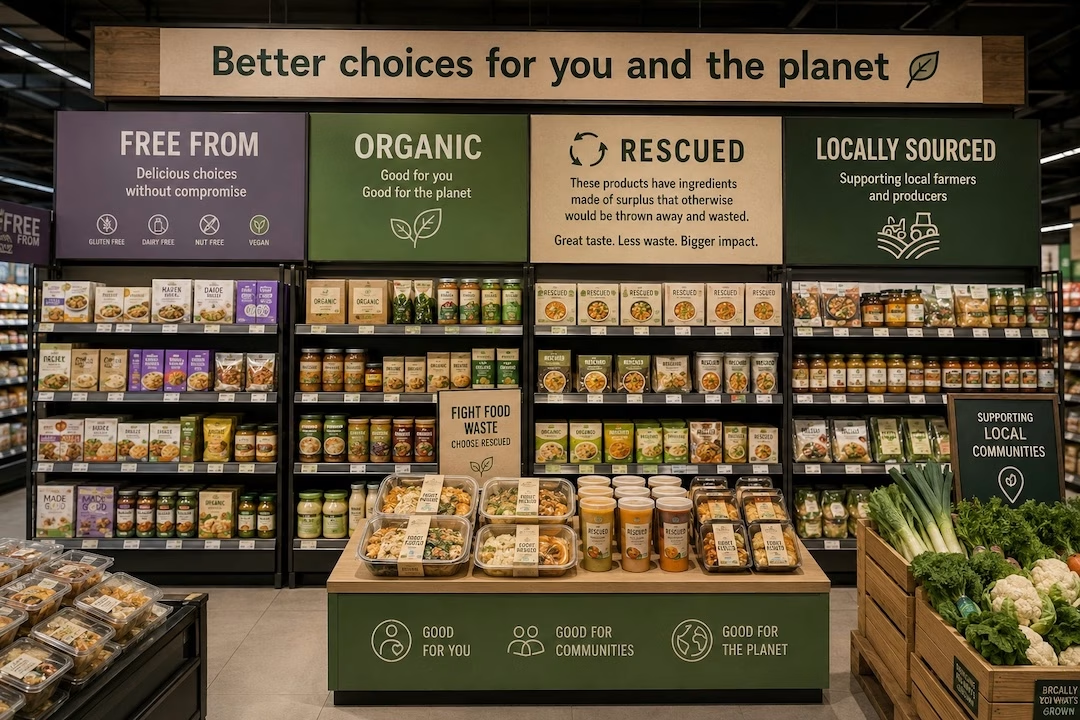
Rescued ingredients: 7 lessons for building a new food sourcing category
Rescued ingredients are often presented as a clever food-waste project: a limited-edition chutney, a seasonal soup or a worthy product with a good story.
However, a recent discussion hosted by ECR Retail Loss with ALDI SÜD and Unverschwendet pointed to a much stronger possibility.
What if rescued ingredients became a practical sourcing capability for the food industry?
That would mean moving beyond occasional products made from surplus food.
Retailers and manufacturers could use suitable surplus as an ingredient in established private-label products, creating demand before the surplus arises and giving producers a dependable alternative route to market.
This is not a substitute for better forecasting, production planning or redistribution to people who need food.
Prevention should still come first.
But biological production and consumer demand will never match perfectly.
Weather changes, cancelled orders, crop flushes, manufacturing variations and shifts in demand will continue to create edible surplus.
The opportunity is to stop treating all of that surplus as an end-of-pipe problem.
Often described elsewhere as upcycled food ingredients, rescued ingredients are edible materials that would not otherwise have reached human consumption but can be safely processed into new, valuable food products.
The language matters. Surplus is not automatically waste, and it isn’t necessarily inferior.
As the ECR Retail Loss food waste guidance explains, surplus exists when supply exceeds demand; it becomes waste when it is ultimately not eaten.
The cases from Austria and New Zealand suggest that a third route is possible: prevent what can be prevented, redistribute what can be redistributed, and transform suitable remaining surplus into ingredients.
What are rescued ingredients?
Rescued ingredients can come from farms, sorting operations, food manufacturers, distribution networks or retailers. The source might be:
- a crop that meets food-quality standards but has no buyer after demand changes;
- fruit or vegetables that are the wrong size or shape for their intended market;
- a production overrun, offcut or side stream that remains suitable for human consumption;
- an ingredient stranded by a cancelled order or packaging change;
- a product such as surplus bread that can be collected, processed and given a longer useful life.
This is wider than the familiar idea of “wonky” produce.
ALDI SÜD and Unverschwendet shared examples including 25 tonnes of pumpkins left after harvest, around 300 tonnes of broken or misshapen carrots from an agricultural cooperative, and 2,500 tonnes of mango purée affected by geopolitical disruption.
Other opportunities can arise in nuts, seeds, coffee, cocoa, meat and food-manufacturing side streams.
In many cases, the food is within acceptable food safety and quality specifications.
The problem is timing, format, location or the absence of an alternative buyer.
If colleagues, suppliers or customers hear “waste ingredient”, they may assume poor quality or compromised food safety.
A rescued ingredient must instead be understood as a controlled, traceable food input:
- identified;
- assessed;
- processed to the required specification;
- and used in an appropriate product.
The ALDI SÜD and Unverschwendet case: rescued ingredients at retail scale
HOFER, ALDI SÜD’s Austrian business, launched the RETTENSWERT or “Worth Saving” private label with Unverschwendet in 2022.
The products use at least one rescued main ingredient sourced from agriculture, sorting facilities or food production.
In the July 2026 presentation to ECR Retail Loss, the partners reported:
- 36 products across 84 varieties;
- more than eight million units sold;
- and more than 1,500 tonnes of surplus food rescued.
- The programme has continued to grow.
Unverschwendet now reports that the partnership has rescued more than 1,500 tonnes, while HOFER’s published account confirms the range’s progress from a 2022 launch to mainstream supermarket shelves.
Those numbers matter, but the strategic shift matters more.
The first phase proved that a dedicated range could work.
ALDI SÜD’s next ambition is to integrate rescued ingredients into products within established private-label ranges.
The meeting heard examples of rescued beans being used in chilli con carne and rescued potatoes in goulash soup, while the recipe, product positioning and familiar packaging remain largely unchanged.
The rescued ingredient is identified through additional on-pack communication.
This changes the potential scale.
While a specialist product might rescue a few tonnes, replacing part of the conventional input in an established soup, sauce, snack or ready meal sold in high volumes could rescue far more.
It also reduces the burden on the shopper.
Customers do not always have to discover a new category, understand an unfamiliar product and change their behaviour.
Rescued ingredients can be built into products they already know and buy.
Participants from ALDI SÜD reported that adding rescued ingredients to existing products produced neither noticeable sales decline nor significant customer concern about quality.
That is encouraging, although it should be treated as programme experience rather than a controlled consumer study.
The larger early challenge was internal: ensuring colleagues understood that surplus did not mean unsafe, degraded or second-rate food.
Why an intermediary may be the critical piece
The idea sounds simple until a buying team tries to source against it.
Conventional food supply chains are designed around planned demand, contracted quantities, repeatable specifications and predictable delivery.
Surplus behaves differently: it can appear quickly, in changing volumes, forms and locations.
So, a retailer cannot add “500 tonnes of rescued carrots” to an annual plan and assume the right carrots will be available at the right time.
Unverschwendet’s role is to create infrastructure between organisations that unexpectedly have surplus and those that can use it. Its work includes:
- actively finding and screening potential surplus;
- checking quality, food safety, traceability, quantity and timing;
- identifying a commercially and technically suitable application;
- arranging processing where the material needs to be stabilised or reformatted;
- matching the resulting ingredient to a manufacturer’s specification;
- coordinating contracts and logistics; and
- monitoring how much surplus is used and what impact is achieved.
Crucially, the intermediary does not necessarily replace the retailer’s supplier base.
It can deliver a rescued ingredient to the retailer’s chosen manufacturer, allowing the conventional supplier relationship and production capability to remain in place.
There is also a question of trust.
Suppliers may be reluctant to tell a powerful retail customer about every overrun, rejected crop or unused side stream.
They may fear that the information will be interpreted as poor forecasting or inefficient production and used in a future commercial negotiation.
An independent intermediary can provide a more trusted route.
It can understand the pressures at both ends, protect appropriate confidentiality and translate an irregular surplus into a credible ingredient opportunity.
Several retailers in our working group identified this mediator role as one of the most important parts of the model.
What Rescued New Zealand adds to the case
The work of Rescued in New Zealand shows that the same principles can be applied to one of the world’s most commonly wasted foods: bread.
Working with Woolworths New Zealand and food rescue partner KiwiHarvest, Rescued takes bread that remains after redistribution to the community and processes it into Rescued Bread Flour.
The company says the resulting ingredient has a two-year shelf life, can replace conventional wheat flour in different proportions and is already used in baking mixes, frozen cakes and muffins, breadcrumbs and Remarkable Tortillas.
This is important for two reasons.
- It shows how rescued ingredients can complement food redistribution rather than compete with it.
Edible products suitable for immediate community use retain that route.
A processing pathway is available for appropriate bread that remains, extending its useful life and retaining more value from the resources already used to make it. - It demonstrates how a single recovered material can become a flexible business-to-business ingredient.
Rescued is not limited to selling one finished “food waste product”.
Its flour can be used by different manufacturers in different categories.
A 2025 Journal of Strategic Marketing study examined Rescued Kitchen as a New Zealand case study.
It found that collaboration was the most prominent theme across its stakeholder interviews.
Growers, manufacturers, retailers, food rescue organisations, technology partners, government and marketing all had a role.
The conclusion closely mirrors the discussion in the ECR meeting: no single organisation can create a functioning market for rescued ingredients on its own.
Environmental evidence must move with the product
It is easy to assume that using surplus must be better for the environment.
The direction is plausible, but credible category building requires measurement rather than assumption.
Environmental engineering students at the University of Auckland completed a cradle-to-gate lifecycle assessment comparing one tonne of Rescued Bread Flour with conventional flour imported into New Zealand.
Their model estimated that the rescued flour produced:
- 57% less greenhouse gas emissions;
- 98% less agricultural land occupation;
- and 99.7% less water depletion.
The main reason was avoided agricultural production.
Conventional flour carries the impacts of growing wheat, whereas the study treated the surplus bread entering the rescued process as a zero-burden material.
The assessment also identified the rescued process’s main hotspot: liquefied petroleum gas used to dry the bread accounted for more than three-quarters of its modelled carbon footprint.
That gives the business a practical improvement target rather than simply a positive claim.
These results are promising, but they should be used with their limitations visible.
The assessment was a commissioned university class project, not a peer-reviewed comparative assertion.
It used specifications for new equipment rather than long-term operating data, drew on some European background datasets, and stopped at the factory gate without modelling use or disposal.
That’s a great example of what responsible evidence should do: quantify the likely benefit, show where the remaining impact sits and identify what needs further validation as production scales.
The same discipline should apply across the category.
Retailers need consistent measures for tonnes rescued, displacement of conventional ingredients, additional processing, transport, yield, cost and environmental impact.
Otherwise, rescued ingredients risk becoming a collection of attractive stories that cannot be compared or defended.
The economics of rescued ingredients: count the whole value chain
Food loss is not free, as the purchase value of surplus food is only its most visible cost.
Staff time, handling, markdowns, redistribution and disposal add more.
ECR Retail Loss research estimates that these hidden costs of unsold food can amount to a further 1.8% of retail sales revenue.
Converting suitable surplus into ingredients can therefore recover value twice: by creating a useful input and by reducing the cost of managing that food as waste.
The benefits can travel through the value chain.
- Suppliers gain a higher-value outlet for food that cannot be sold as originally intended.
- Manufacturers gain a substitute for ingredients they already purchase.
- Retailers may improve supply resilience, create differentiated products and reduce demand for newly produced ingredients.
Whether the gains appear as lower prices, stronger supplier margins or investment in further innovation will vary by market, but the food system becomes more productive when more value is retained.
There is also evidence that credible sustainability attributes can support commercial performance.
The latest Sustainable Market Share Index from NYU Stern, using Circana purchasing data, found that sustainability-marketed products grew 4.9 times faster than conventional counterparts over five years and carried an average price premium of 26.6%.
This does not mean every rescued product will command a premium.
The research covers sustainability-marketed consumer products generally, not rescued ingredients specifically.
However, it does show that sustainability can create commercial value when quality, availability, price and communication are right.
Nor will every rescued ingredient automatically be cheaper. Collection, testing, processing and transport all cost money.
The appropriate comparison is therefore the economics of the whole value chain, including avoided disposal costs, value recovered from previously unsaleable surplus, reduced demand for conventional ingredients and any additional margin from differentiated products.
As volumes increase, more standardised supply, steadier demand and more efficient processing should improve that equation.
Success will be when rescued ingredients are no longer treated as a premium novelty, but become a normal and competitive part of food production.
Marketing matters, but clarity matters more
The phrase “rescued ingredients” is emotionally accessible.
Most people understand that wasting good food is undesirable.
Yet the language can also create an unintended question: was this ingredient taken from something already classed as rubbish?
Clear communication must answer that question without exaggeration. Customers and colleagues need to understand:
- why the surplus arose;
- why it remained safe and suitable for human consumption;
- what processing and quality controls were applied;
- which ingredient was rescued;
- how much of it is present;
- and what measurable difference its use made.
There is encouraging evidence. A 2025 study in Food Quality and Preference found that a “rescued” ingredient claim increased perceived sustainability and healthiness, which in turn supported purchase intention.
It did not reduce expected taste. The effects were stronger when people were familiar with the ingredient being rescued.
That last point is useful for retailers. Bread, beans, potatoes, carrots and apples are easy to recognise.
A clear explanation of why a familiar food became surplus may be more effective than an abstract claim about saving the planet.
The product must still compete on the fundamentals. Taste, safety, quality, availability and price remain essential.
Rescue is a reason to believe in a good product, not a reason to excuse a poor one.
Seven lessons for making rescued ingredients scalable
- Start with prevention, then design the next-best route
Rescued ingredients should not reward avoidable overproduction. Retailers and suppliers still need to improve forecasting, specifications, ordering, shelf life and operations. The sourcing model should address suitable surplus that remains after realistic prevention and redistribution options. - Treat surplus as a potential input before it becomes waste
The decisive change is timing. If a retailer waits until food is about to be discarded, its options are already limited. Mapping likely crop gluts, production side streams and recurring overruns creates time to test safety, develop specifications and find a manufacturing use. - Build demand through mainstream products
Dedicated rescued ranges are valuable test beds. The bigger opportunity is to use rescued ingredients in established products and categories where demand already exists. Private label gives retailers a particularly strong route because they can influence formulation, supplier relationships, packaging and customer communication. - Give an intermediary permission to solve the messy middle
Irregular supply, multiple specifications, commercial sensitivity and fragmented data make this difficult to manage as a normal buying task. A capable intermediary can aggregate opportunities, protect trust, coordinate processing and bring retailers, suppliers and manufacturers into the same conversation. - Make the work genuinely cross-functional
Buying cannot deliver this alone. Sustainability teams understand impact; merchants understand customers and category economics; technical teams protect food safety and quality; manufacturers understand formulation; marketing makes the proposition legible. A shared owner, decision process and success measure are needed from the start. - Measure the commercial and environmental case together
Tonnes rescued are not enough. Retailers should also understand the full cost, yield, transport, processing requirement, sales performance and environmental outcome. A programme that looks positive on waste but cannot meet quality, availability or price requirements will not scale. Equally, a commercially viable product without credible additional environmental benefit should not carry an inflated sustainability claim. - Build a portfolio, not a procession of pilots
One-off projects are useful for learning, but they repeatedly incur development costs. Scale will come from common standards, repeatable contracting, a qualified ingredient pipeline and products across several categories. Each successful application should make the next one easier.
What’s not yet been proved
The evidence is encouraging, but the category is not fully formed. Important questions remain:
- Can variable surplus provide reliable volumes without compromising specification?
- When are rescued ingredients cost-competitive after collection, processing, testing and transport?
- How should retailers verify that an ingredient would genuinely have left human consumption?
- Which claims, standards and certification will travel across markets?
- How should the benefits be allocated between growers, intermediaries, manufacturers and retailers?
- Can the model scale without diverting suitable food from community redistribution?
- Will positive customer response persist across less familiar ingredients and more product categories?
These set the agenda for the next stage of work.
The current evidence supports a more ambitious starting point.
HOFER and Unverschwendet have shown that rescued products can reach millions of shopping baskets.
ALDI SÜD is exploring how rescued inputs can move into established private-label products.
Rescued NZ has turned surplus bread into a commercially usable ingredient with applications beyond its own brand.
Academic work is beginning to explain the collaboration and communication needed, while life-cycle assessment is starting to quantify the environmental case.
A third route for unavoidable surplus
The most valuable outcome may be a change in the options available before surplus occurs.
A retailer facing an unexpected crop flush or a supplier dealing with a cancelled order should not have only two choices: accept food it cannot sell or leave the producer with the loss.
A working rescued ingredients market creates a third route: “We cannot sell it in its original form, but we know where else it can go.”
If retailers, producers, manufacturers and intermediaries can make that sentence routine, rescued ingredients stop being a sustainability side project.
They become part of the infrastructure of a more efficient food system.
ECR Retail Loss will return to this subject in a year. Register to join the conversation about reducing producer food waste through rescued ingredients in retail programmes.
To learn more about Worth Saving or rescued ingredients, contact the Worth Saving team at hi@worthsaving.food.
Frequently asked questions about rescued ingredients
What are rescued ingredients?
Rescued ingredients are edible food materials that would not otherwise have reached human consumption but are safely recovered, processed and used in new food products. They may come from agricultural surplus, manufacturing overruns, offcuts, side streams or products such as surplus bread.
Are rescued ingredients the same as food waste?
Not necessarily. Food surplus exists when supply exceeds demand. It becomes food waste when it is not consumed by people. Rescuing a suitable surplus ingredient creates another route before that outcome, subject to food safety, quality and traceability controls.
How can retailers use rescued ingredients?
Retailers can create dedicated rescued products, introduce rescued inputs into established private-label products, or help connect supplier surplus with manufacturers that can use it. The most scalable approach is likely to combine existing customer demand with an intermediary capable of managing irregular supply and specifications.
Do customers accept products made with rescued ingredients?
Early programme experience from ALDI SÜD was positive, and a 2025 consumer study found that a rescued-ingredient claim supported purchase intention without reducing expected taste. Acceptance still depends on clear communication, familiar ingredients and the product meeting normal expectations for quality, safety, availability and price.




