

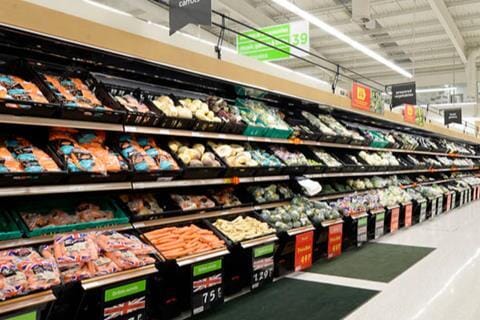
Food Waste: Introducing Nine Hot Start-Ups
The food waste working group reviewed in January 2026, nine highly relevant start-ups, each with new ideas and technologies to help retailers reduce packaging from packaging, to smart apps to insects. The list who presented are below.
BlakBear
Problem: Static use-by dates are conservative, one-size-fits-all, and drive unnecessary waste across protein and fresh categories.
Approach: BlakBear embeds miniature gas and temperature sensors in packs to measure real spoilage indicators, creating a digital, dynamic shelf life based on actual product condition rather than assumptions. BlakBear works in parallel with date labels, making them more precise and tailored to each retailer.
Reasons to believe: Peer-reviewed science, validation with labs (e.g. Campden BRI) and food manufacturers, and live enterprise-wide deployments with major meat producers in the UK, US, and Canada. Proven links between sensor data, microbial counts, and odour scores.
How to partner: Retailers send sensor-enabled packs through selected supply chains or depots. Insights are used to adjust shelf-life rules, identify cold-chain failures, and extend selling time—without removing current date labels. Engagement typically happens in parallel with existing meat suppliers, many of whom are already BlakBear customers.
Contact: max@blakbear.com
URL: BlakBear
________________________________________
Martee AI
Problem: Food-to-go and short-life categories suffer from volatile demand, manual forecasting, labour dependency, and high waste or lost sales.
Approach: Martee uses AI driven demand forecasting and optimisation to automate daily production and ordering plans for fresh, baked, and hot food to go. We generate store level recommendations that balance availability and waste in real time, and continuously improve as performance data flows back in.
Reasons to believe: We are purpose built for food to go and short life categories where standard ERP logic breaks down. We have already delivered measurable commercial impact with UK and European operators, including double digit waste reduction, increased sales through improved availability, and time savings for store teams.
How to partner: We keep pilots simple and fast to launch. We integrate with your sales and product data, agree a subset of stores, then start producing daily production and or ordering recommendations. Results are tracked against waste, availability, and sales from week 1. Once value is proven, we roll out quickly across additional sites and scale estate wide.
URL- martee.ai
Contact: LinkedIn
Contact: martee.ai
Contact: harry@martee.ai
________________________________________
Remy
Problem: Household food waste remains high due to households’ lack of oversight, inspiration and time to manage their kitchens efficiently while retailers lack commercial incentives to influence responsible consumption.
Approach: Remy is building the digital infrastructure for modern food retail to drive customer efficiency while growing retailer profitability by offering a suite of modular, AI-driven tools that optimise recipe discovery, management and shopping, thus, enhancing loyalty, average order value and satisfaction while drastically reducing household food waste and cost per serving.
Reasons to believe: Tens of thousands of users, strong engagement, and reported uplifts in average order value (+15%) and repeat purchasing (+30%). Strong founding team (2nd time founder; ex-Ocado, Carrefour) backed by experienced retail (Tesco, Sainsbury) and tech (HelloFresh) advisors
How to partner: Remy offers immense flexibility and cost-effectiveness, offering integrated partnerships via white-label versions, API integrations into existing ecosystems, or co-marketing within Remy’s consumer platform while the retailer retains full data ownership and brand control.
Contact: conrad@remyapp.io
Contact: +49 17672806506
URL: remyapp.io
Contact: Book time with me
________________________________________
Auralytica
Problem: Date labels don’t reflect real freshness, confusing consumers and triggering premature waste in stores and homes.
Approach: Auralytica develops edible, dye-free, electronic-free colour-changing films that respond to pH or spoilage gases, providing a visual freshness indicator directly on packaging.
Reasons to believe: Strong scientific foundation (structured colouration), early prototypes, and a clear roadmap to ultra-low unit costs via roll-to-roll manufacturing.
How to partner: Retailers engage through pilots with suppliers to test integration into packaging, define data needs (visible or invisible spectrum), and explore operational or consumer-facing use cases before scale-up. Auralytica is early into their journey, retailer insight now allows efforts to be directed in the most efficient way. As Auralytica is early in its journey, retailer insight now helps ensure development is directed toward the highest-impact, commercially viable use cases.
Contact: Anna Winter, CEO, anna@auralytica.co.uk
URL: Auralytica | holographic hydrogel sensors
________________________________________
Ostras
Problem: Retail surplus is costly to manage, while value-seeking consumers struggle to find short-dated deals in time.
Approach: Ostras gamifies surplus reduction via a consumer rewards app: shoppers earn points for purchasing short-dated items (≤5 days), redeemable as gift cards or partner discounts.
Reasons to believe: Live pilots, no POS integration required, and strong retailer interest as a complement—not replacement—to markdowns and redistribution.
How to partner: Retailers onboard stores without hardware or operational changes. Ostras drives traffic, improves sell-through, and provides behavioural insights, starting with regional or category-level trials.
Contact: evelienmoriau@ostrasdescuentos.com
Contact: WhatsApp: +34670474632
LinkedIn: https://www.linkedin.com/in/evelienmoriau/
________________________________________
Zeero
Problem: Overstocks, delists, and range changes create large volumes of “problem stock” that traditional markdowns can’t clear efficiently.
Approach: Zeero is a B2B/B2C digital marketplace acting as a “Plan B” for surplus—moving stock via internal transfers, local businesses, or consumers before disposal. We have built in Machine learning that can report on stock holding/ levels based on events calendars and temperatures.
Reasons to believe: Backed by major technology partners, international pilots, and a subscription model aligned with waste reduction rather than commission maximisation. Retailers set the price and take 100% of the revenue.
How to partner: Retailers integrate via API or webhook (manual uploads are possible) define approval rules, and pilot on delists or clearance categories – from manufacturer, to DC to store (we can also be reactive to delivery vans on the road with substitutions or rejected orders!)
URL: www.zeero1.com
Contact: Tom Lillywhite – Founder – tom@zeero1.com
________________________________________
ToTable
Problem: Consumers face complexity balancing nutrition, budget, sustainability, and waste—while retailers struggle to align these needs profitably.
Approach: ToTable uses a medical-grade, explainable AI engine to generate personalised meal plans that optimise nutrition, shelf life, and retailer objectives simultaneously.
Reasons to believe: Built by PhDs with strict regulatory alignment, transparent logic (not black-box AI), and a focus on safety-critical dietary constraints.
How to partner: Retailers pilot as a branded digital layer or integrated service, using ToTable to guide shoppers toward products that sell better, waste less, and meet health goals.
Website: https://totable.io
Email: phil@totable.io
Phone/WhatsApp: +1 (703) 593-0007
________________________________________
The Insect Cafe
Problem: Even with prevention, unavoidable food surplus remains—while protein supply chains are fragile and carbon-intensive.
Approach: The Insect Cafe converts compliant retail food waste into insect feed, producing high-protein ingredients for human consumption via modular, local insect farms.
Reasons to believe: Operating for two years, consumer sales revenue, regulatory compliance with the FSA, strong media exposure, and a functioning insect farm model.
How to partner: Retailers participate in feasibility pilots (e.g. on-site or local surplus streams) to test compliance, economics, and scalability—typically starting with regional trials.
Email: Nahla: nahla@theinsectcafe.com
URL: www.theinsectcafe.com
________________________________________
AIPERIA
Problem: Fresh and ultra-fresh categories like bakery suffer from poor planning, leading to empty shelves or daily waste.
Approach: Aiperia uses AI-driven forecasting and optimisation to generate profit-maximising production plans, factoring in equipment, labour, margins, and demand drivers.
Reasons to believe: Deployed in thousands of stores across Europe, grounded in decades of research, and proven to reduce waste while improving availability.
How to partner: Retailers pilot by integrating sales and production data in bakery or food-to-go categories, scaling store-by-store once value is demonstrated.
Website: https://aiperia.com/en/our_ai
Contact: Melanie.Adelhardt@aiperia.com




