

Self-checkout host training: A smarter approach for 2026
Why self-checkout host training matters more than ever
Self-checkout has become one of the most visible (and sometimes controversial) parts of modern retail. It promises faster shopping and lower operating costs, yet it also introduces new operational challenges.
Shrink, customer frustration and staff confidence are now closely tied to how well stores manage their self-checkout areas.
This is why self-checkout host training has become such a critical topic for retailers. The technology itself is only part of the equation. In many stores, the real difference between a smooth self-checkout experience and a stressful one comes down to the colleague supporting it.
A confident host can reduce friction, help customers quickly and intervene early when problems arise. A poorly supported host, on the other hand, may struggle to manage multiple machines, customers and alerts at the same time.
To explore how self-checkout host training might evolve, a recent retailer focus group brought together front-end and loss-prevention experts from five major UK supermarket retailers.
The goal of the focus group was to explore current practices and to reflect on how AI based immersive training may augment and support self-checkout host training going forward.
For some perspective, a major study by ECR Retail Loss highlighted just how demanding the role has become. Many self-checkout supervisors are managing seven or more machines at once, often alone, with peaks of activity that are difficult to control.
Two-thirds of supervisors say they cannot cope with the workload during busy periods, and only 37% feel able to manage their assigned machines consistently. In this context, the need for effective self-checkout host training becomes less about optimisation and more about basic operational resilience.
Starting with the real problem
Retailers are often familiar with a particular pattern in innovation: solutions sometimes appear before the industry has fully defined the problem they are meant to solve.
This session took the opposite approach. Rather than presenting a polished training programme, the discussion focused on co-creating a better way of self-checkout host training.
We did this by working directly with the people responsible for front-end operations and loss prevention.
The objective was simple: design something that reflects the messy reality of the shopfloor rather than the tidy structure of a training manual.
Participants explored what the ideal self-checkout host looks like, how existing training works today and where the biggest gaps appear in practice.
What does the ideal SCO host look like?
The first exercise in the focus group asked a simple question: What does a great SCO host actually look like?
The answers quickly revealed how complex the role has become. The ideal SCO host is:
- Confident and comfortable talking with customers
- Naturally good at small talk and engagement
- Highly observant and aware of potential issues
- Strong at multitasking across multiple checkouts
- Able to remember faces and recognise patterns
- Comfortable resolving tension and de-escalating situations
- Customer-focused while remaining alert to possible loss
However, the reality on the shop floor is often very different. With many hosts managing multiple machines under pressure, consistently delivering this level of performance is a significant challenge without the right training and support.
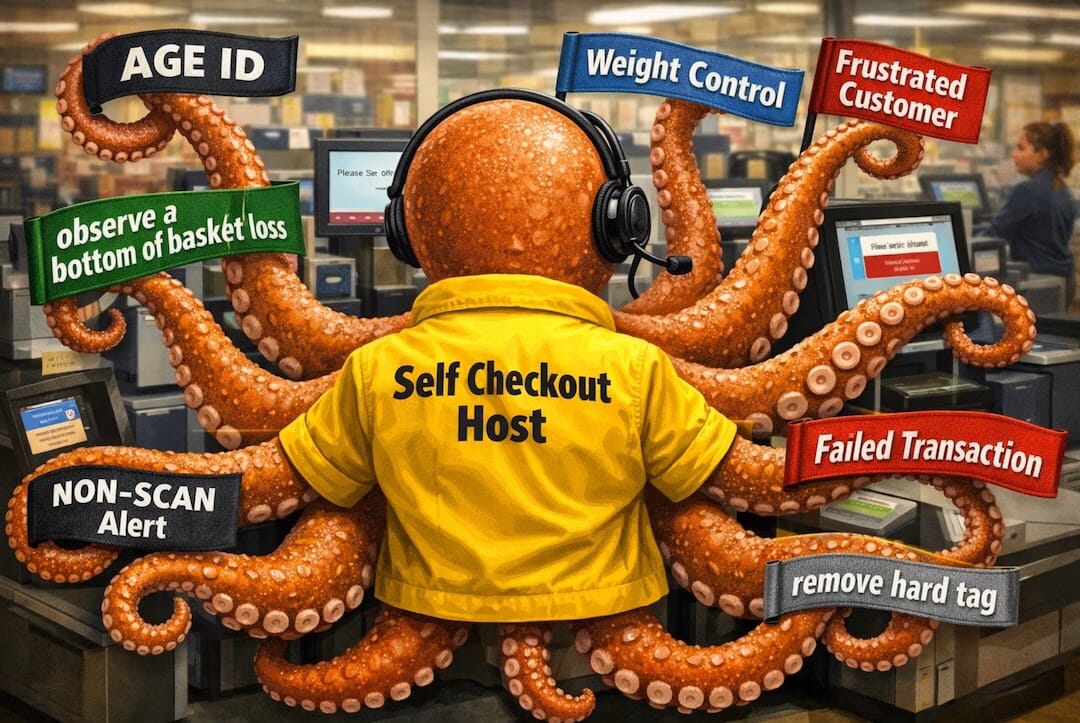
One participant summarised the role memorably. A successful SCO host needs to behave like an octopus. With eight arms to manage several things at once, while maintaining the calm customer presence of an airline steward.
This description highlights why self-checkout host training cannot focus solely on procedures or system prompts. The role requires judgement, communication skills and situational awareness.
The limits of traditional training
Once the group had described the ideal self-checkout host, the conversation turned to the training that currently exists in many retailers.
Participants identified several common challenges that affect self-checkout host training across the industry.
Reliance on store experts
In many stores, the most effective training happens informally. Experienced colleagues pass knowledge to others through coaching and example.
This approach works well when those colleagues remain in their roles. But retail turnover means expertise can disappear quickly when key individuals move on.
Computer-based training can only go so far
Digital learning modules are useful for explaining systems and procedures. They can show colleagues what buttons to press or how alerts work.
However, self-checkout host training involves far more than technical knowledge. Handling frustrated customers, identifying suspicious behaviour and balancing service with vigilance are difficult skills to teach through slides or quizzes.
In-store training is expensive and hard to sustain
Face-to-face training often produces better behavioural learning. Yet delivering this consistently across large store networks is challenging.
Retailers must consider the cost of trainers, time away from the shop floor and the impact of staff turnover.
One participant compared the process to painting the Forth Road Bridge. Once you finish training your store universe, because of the high turnover in staff labour, you really have to start again as often more than half of the associates in the store would have joined the business after the initial training.
The reality of the training challenge is reflected in our data. Around one-third of self-checkout supervisors report receiving just one hour of training, and 60% receive half a day or less.
Given the complexity of the role (balancing customer service, loss prevention and system management) these gaps in self-checkout host training significantly increase both operational pressure and risk exposure.
Why experience matters in SCO host training
A key theme emerging from the focus group was that many self-checkout hosts develop their skills primarily through experience.
Unfortunately, that experience often comes during difficult situations on the shop floor.
Hosts regularly face scenarios such as:
- Customers scanning items incorrectly
- Unexpected system alerts
- Frustrated shoppers when machines fail
- Situations where theft may be occurring
- Moments where tension begins to escalate
This pressure is compounded by the behaviour hosts encounter. Around a third of supervisors report experiencing verbal abuse or violence at self-checkout every week, making it one of the most challenging customer-facing roles in the store.
These situations define the reality of the role. Yet they are rarely replicated effectively in traditional training environments.
This gap explains why many retailers are now exploring more immersive approaches to self-checkout host training.
Exploring more immersive training
During the focus group, participants reviewed a prototype AI training concept designed to simulate real self-checkout interactions.
The idea was to create a training environment where colleagues can practise decisions and behaviours without the pressure of a real customer standing in front of them.
Initial feedback from retailers was positive.
Participants described the learning experience as engaging, interactive and different from conventional training. Importantly, it allowed colleagues to experiment with decisions and immediately see the consequences.
This feedback loop was seen as a particularly valuable feature of modern self-checkout host training.
Instead of simply being told the correct answer, colleagues can learn by trying different approaches and understanding why certain responses work better than others.
The role of customer service in preventing conflict
An important insight from the focus group discussion was that self-checkout host training often focuses heavily on risk and intervention.
However, retailers noted that many problems at self-checkout can be prevented through strong customer engagement.
Existing conflict management training modules are often designed for security staff or store managers.
Self-checkout hosts operate in a different environment. Their role is usually about preventing situations from escalating rather than responding once conflict has already started.
This means effective self-checkout host training should include topics such as:
- Proactive customer engagement
- Recognising early signs of frustration
- Reducing friction around system alerts
- Maintaining a calm and confident presence
In many cases, good customer service can also act as an effective form of loss prevention.
What the data tells us about self-checkout host training
- Many supervisors manage seven or more self-checkout machines alone
- Two-thirds say they cannot cope at busy times
- A third experience abuse or violence weekly
- Half of self-checkout losses are believed to be deliberate
- One-third receive just one hour of training
What happens next?
The focus group concluded with a number of practical next steps.
Participants were invited to test the prototype AI training concept on their own devices and explore the modules further. Retailers interested in the approach may move into pilot programmes to evaluate how the training performs in real store environments.
There was also discussion about expanding the content to include additional customer service modules designed specifically for SCO hosts.
ECR Retail Loss may also support further testing by gathering feedback from self-checkout hosts themselves.
Importantly, retailers participating in trials have been encouraged to share the results openly so the wider industry can learn from the findings.
The bigger lesson for retail
Self-checkout technology will almost certainly continue to expand across retail.
But technology alone cannot solve the operational challenges that come with it.
The human role at the centre of the self-checkout area remains critical. Strong self-checkout host training can help colleagues manage complex interactions, reduce customer frustration and intervene effectively when risks emerge.
Without that support, even the most advanced self-checkout systems can struggle.
The discussion from this focus group suggests the industry may be entering a new phase of thinking about self-checkout host training. One that focuses less on procedures and more on practical experience, judgment, and customer interaction.
If retailers can find better ways to prepare colleagues for the reality of the role, the benefits could extend well beyond the checkout area.