

How to improve inventory accuracy to boost sales
Wrong inventory records create a special kind of retail chaos. How to improve inventory accuracy is an increasingly important topic for retailers worldwide.
The shelf says “out of stock”. The system says “plenty in the back”. E-commerce orders get promised, then cancelled. Store teams waste hours hunting for items that are not there. And meanwhile, excess stock sits in the wrong place, slowly turning into markdowns, waste, or shrink.
This week, ECR Retail Loss is publishing two new research reports to help retailers tackle that problem properly, starting with the basics: agreeing what inventory accuracy actually means, and then treating it like a business capability, not a once-a-year stocktake exercise.
The evidence behind the topic is already uncomfortable. Previous ECR Retail Loss research suggests that more than 60% of inventory records contain inaccuracies. When retailers prioritise inventory record accuracy, the prize is big: improved on-shelf availability, better customer experience, reduced waste and shrink, and an uplift in sales of 4–11%.
Why does inventory record inaccuracy persist?
One reason is that “inventory record accuracy” sounds like a single, obvious metric. In reality, it is a bundle of different measures, each with different strengths and blind spots. Retailers can end up comparing performance across stores, categories or banners while using metrics that are not entirely comparable, and then wondering why the numbers do not translate into better decisions.
It can also seem like a complicated process. As one retailer told the researchers, “We do not measure the stock accuracy, because measuring stock accuracy is very expensive.”
And in many organisations, the ultimate responsibility for ensuring accuracy is hard to define. Another retailer summed the issue up: “It is very hard to attribute the problem to an underlying cause, and therefore no one can be deemed responsible for the problem.”
Therein lies the problem. This is not just an operational nuisance. Improving inventory record accuracy is a strategic issue that touches availability, loss, productivity and customer trust. And if it is not measured consistently, it is very hard to fix. Indeed, unless businesses actively look at how they measure stock accuracy (or why they don’t), they may be missing some extremely important management information, creating a false sense of security.
Two new reports, one shared goal: improved inventory accuracy increases sales.
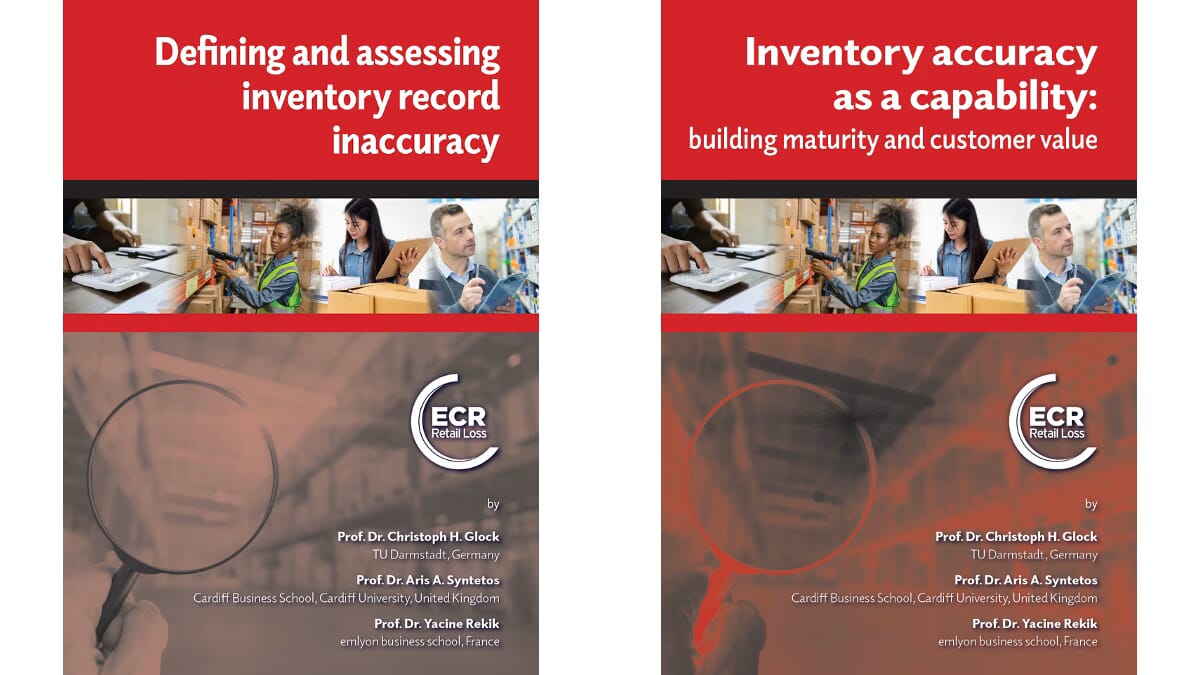
ECR Retail Loss has published two complementary reports, both free to download – Fixing inventory record inaccuracy, and Inventory accuracy as a capability: building maturity and customer value
Read together, they move from “how do we measure this properly?” to “what do we actually do about it, week in week out?”
How to improve inventory accuracy
Fixing inventory record inaccuracy – is deceptively simple: define the problem clearly, using measurement that supports the decisions you need to make.
The researchers identify eight distinct ways that retailers and academics measure inventory record inaccuracy. These include shrink-based measures, binary measures (is the SKU accurate or not?), absolute measures, and percentage error approaches such as MAPE and sMAPE.
None of these are wrong. But they are different. And if you are benchmarking accuracy without agreeing which one you are using, you can end up chasing phantom progress, or missing real risk.
A key contribution of the report is its practical focus. It goes beyond a simple description of measurement approaches. It shows how each one behaves using worked examples, and why some measures can produce misleading conclusions depending on the category, the store, or the underlying distribution of errors.
This matters because the same headline score can hide very different realities. A “good” accuracy number might still include big errors on high-velocity items. A “bad” number might be driven by low-volume SKUs that do not materially affect availability. Without clarity, teams can spend time arguing about the numbers which might slightly miss the mark, rather than improving the business.
Inventory record accuracy as a capability
The second report, Inventory accuracy as a capability: building maturity and customer value moves beyond the theoretical into the extremely practical. When it comes to how to improve inventory accuracy – this report shows how to build and improve the internal systems that count.
It frames inventory accuracy as a capability that can mature over time. Not a siloed stock control issue, and not just a systems project. Something that touches leadership priorities, incentives, processes, and cross-functional collaboration.
It sets out 11 ways to build organisational maturity, linking improvements in inventory record accuracy directly to customer value, reduced out-of-stocks across channels, reduced shrink, stronger margins, and greater loyalty.
In practice this moves the research from theory to action. It becomes less about “accuracy” in the abstract, and more about how to improve operational efficiency in a way that drives more sales. If different teams are incentivised in different directions, it is easy for record accuracy to degrade even when everyone is doing their job “properly”. The capability lens works across teams. It prompts a broader question: what does the business reward, and what does the business tolerate?
Academic excellence underpins ECR Retail Loss research
Both reports draw on deep industry insight, and academic rigour.
The research is grounded in 25 in-depth interviews spanning retail sectors, business models, geographies and senior roles, followed by a verification workshop with 46 retail experts to validate findings and refine the implications for practice.
The research team comprises:
• Professor Dr Christoph H Glock (Technical University of Darmstadt, Germany)
• Professor Dr Aris A Syntetos (Cardiff Business School)
• Professor Dr Yacine Rekik (emlyon business school, France)
Download the reports
Both reports are free to download now:
Fixing inventory record inaccuracy, and Inventory accuracy as a capability: building maturity and customer value.
If you are working in availability, loss, waste, store productivity, or omnichannel performance, these reports on how to improve inventory accuracy are a useful place to start.
Because before you can fix the problem, you (and just as importantly) your colleagues all need to agree what the problem is.
The same academic team also runs inventory record accuracy training where the three Professors look at practical implications of their research. The 2026 IRI Training course in Cardiff on 9 and 10 December covers the drivers of stock record inaccuracies, how to articulate the business case for improvement, countermeasures to enhance accuracy, and how to use research insights in practice. It is designed for loss prevention, supply chain and operations leaders and uses interactive exercises and gamification alongside academic instruction.