

Body Worn Cameras in Retail in 2026: A journey not a project
Body worn cameras case study – The evolution of body worn cameras in retail
This article draws on a recent ECR Retail Loss working group meeting, where two large grocery retailers shared how their deployments have evolved over several years.
The discussion sits within our wider work on retail loss, safety and security and video in retail, and builds on the findings of our retail CCTV strategy research.
What follows is a practical account of what we heard worked, what did not, and how both retailers moved from reactive hardware trials to a connected safety capability.
From experimentation to operational capability
The journey of body worn cameras at both retailers is best understood as a multi-year evolution from experimentation to embedded operational capability.
What began as a reactive, hardware-led initiative and rapid response to a growing problem of physical and verbal abuse has matured into a data-driven safety capability that is reshaping how retailers think about colleague protection, evidence, and real-time intervention.
Version 1: solving an urgent problem with blunt tools
In the earliest phase, both retailers were responding to a growing but poorly understood problem.
At one, a structured incident reporting system revealed the true scale of violence and aggression in stores, exposing how underreported and under-managed these incidents had been.
The initial deployment of body worn cameras was thus driven by necessity rather than design maturity. Devices were issued first to security officers, using basic hardware that relied on inconsistent connectivity, ageing infrastructure, and limited integration with wider systems.
Early results were encouraging, including a significant reduction in aggression. But the limitations of this first generation became apparent quickly.
The technical and operational limits of body worn cameras V1
The first generation of body worn cameras depended on 3G connectivity, which proved unreliable in many store environments. Retailers had little visibility over whether cameras were functioning or even online.
Hardware durability was another issue. Microphones failed, screens broke, and serial numbers wore away to the point that devices could not be tracked or serviced effectively.
And they weren’t designed for a diverse retail workforce. Harnesses were impractical, uncomfortable, and raised hygiene and inclusivity concerns, particularly for female colleagues.
Branding and visibility were also overlooked, diminishing the deterrent effect that cameras could provide.
Early deployments at both retailers lacked proactive monitoring, so faults were only discovered after incidents had occurred. And there was no automated health check for key components such as audio, forcing manual and highly inefficient workarounds.
Integration with other systems was minimal, creating friction in evidence retrieval and limiting the ability to scale the solution.
V1 worked as a proof of concept. It lacked the resilience, usability, and intelligence required for enterprise-wide adoption.
Version 2.0: embedding cameras in a wider safety ecosystem
As both retailers progressed developed their capabilities, their focus shifted from deploying cameras to embedding them within a broader operational and technological framework.
The transition to Version 2.0 reflects improvement across several critical areas.
1) Reliability and visibility as foundations
Retailers introduced proactive device monitoring, so cameras were online, functional, and capable of capturing usable evidence at all times.
Firmware updates, including automated microphone self-checks, addressed earlier blind spots and reduced the risk of unusable footage.
Hardware design was refined, with more robust components, clearer service status indicators, and simplified docking systems that reduced the likelihood of devices going offline due to basic setup issues.
2) Usability and colleague adoption
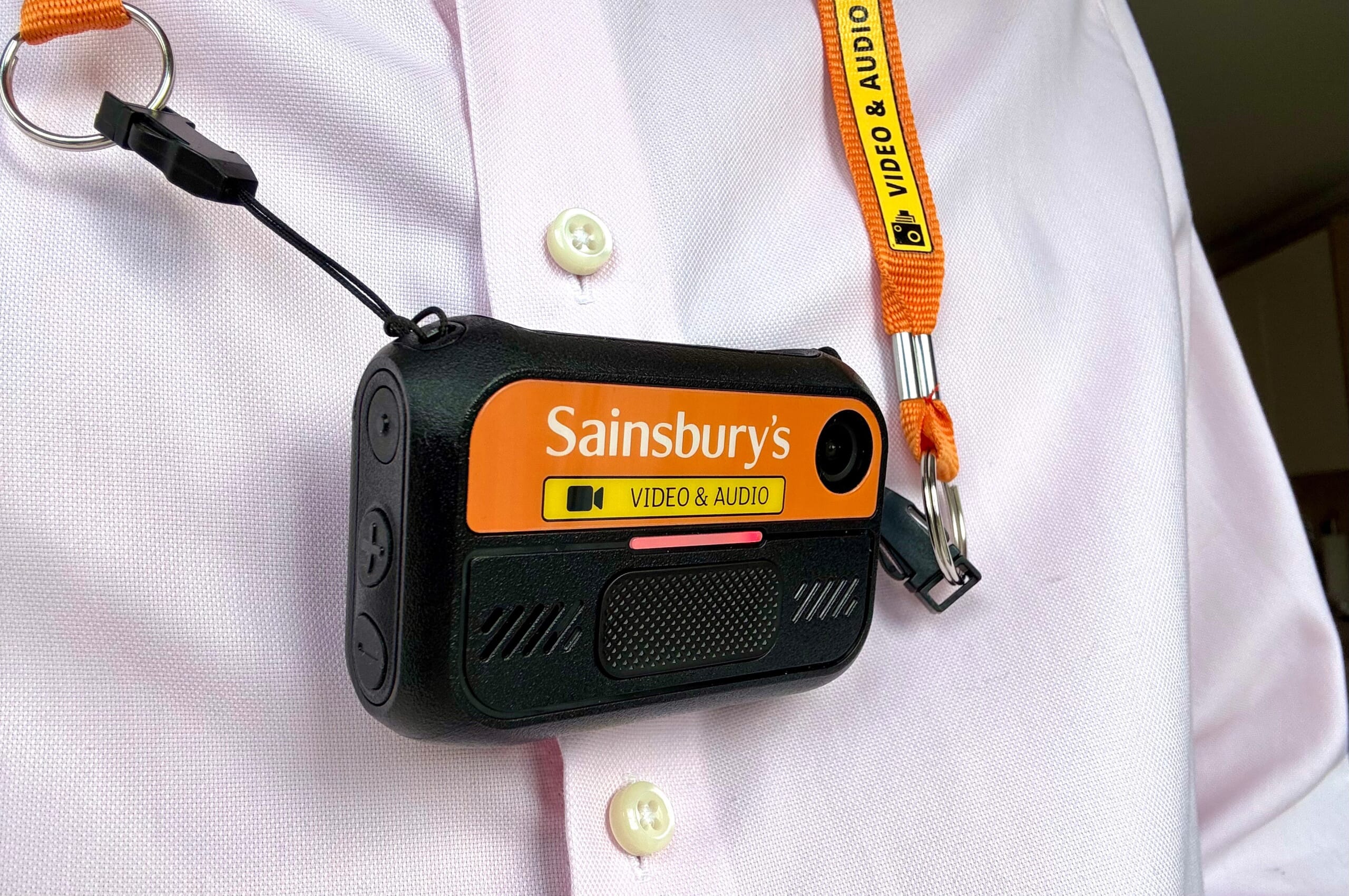
The shift away from harnesses to lanyards and integrated uniform attachments improved comfort and inclusivity.
Simplified user interfaces kept activation intuitive even in high-pressure situations.
Retailers also recognised the importance of branding, using clear visual cues to reinforce the presence of the technology and enhance deterrence.
Positioning cameras as a safety tool rather than a surveillance mechanism helped to build trust among colleagues and unions. This was repeatedly flagged as essential to successful rollout.
3) Integration and data capability
One of the retailers had developed a centralised “safe and secure” platform to monitor usage and compliance, illustrating how body worn cameras are now part of a wider digital ecosystem, enabling real-time analytics, compliance monitoring, and evidence management.
Dashboards tracking usage, device health, and assumed loss have also given operational leaders unprecedented visibility. What was once a passive tool is now an actively managed asset.
This has also improved evidential outcomes, with both retailers reporting significant increases in the quality and availability of footage used in prosecutions.
From retrospective evidence to real-time intervention
The most significant shift, however, is the move from retrospective evidence to real-time intervention.
Live streaming and two-way audio represent a fundamental change in capability.
At one of the retailers, cameras now connect directly to an alarm receiving centre, allowing operators to see and hear incidents as they unfold. The next step is the ability to communicate back to colleagues in real time.
Other retailers are pursuing the same ambition: “in the moment” support systems that can de-escalate situations before they escalate into harm.
Different governance models, same direction of travel
Operationally, retailers have refined how cameras are deployed and governed.
One retailer has embedded them into personal protective equipment policies, making them mandatory for specific high-risk roles.
Another has taken a more flexible approach, ensuring universal access while encouraging adoption through culture and design.
Both models point to the same insight: successful deployment is not about the technology alone, but about aligning it with organisational values, risk profiles, and workforce dynamics.
What other retailers added to the discussion
Other retailers in the working group reinforced this narrative. They raised similar challenges and aspirations, from privacy considerations and union engagement to the exploration of new use cases.
Some have moved towards continuous recording to remove the burden of activation from colleagues in high-stress situations.
Others are still navigating early-stage trials, with a strong emphasis on colleague safety as the primary value proposition.
International perspectives added further nuance. Differing regulatory environments and cultural expectations shape deployment strategies, although the underlying objectives remained consistent.
Adjacent use cases are starting to emerge
The extension of body worn cameras to delivery drivers and maintenance teams at one retailer shows how the technology is moving beyond traditional loss prevention into a broader safety and operational tool.
Experimental applications, such as inventory monitoring through wearable cameras, hint at a future where the technology could play a role in productivity and store operations. This will require careful management of colleague trust.
A journey, not a deployment
The journey from V1 to V2.0 is a story of maturation.
Early deployments proved the concept but exposed significant limitations in reliability, usability, and integration.
Through iterative learning, collaboration with technology partners, and continuous engagement with colleagues, retailers have turned body worn cameras into a core component of their safety strategy.
The result is not just better evidence. It is a more proactive, connected, and colleague-centric approach to managing risk.
For other retailers, the message is clear. The value of body worn cameras lies not in the device itself, but in the ecosystem around it.
Success requires investment in data, integration, governance, and culture, not just hardware.
Those who approach it as a journey rather than a deployment will be best placed to realise the full potential.
For more background on the use of body worn cameras, check out our previous podcast episode on body worn cameras in retail.